We have our own marking department in Poland.
We work using only brand-name machines and components.

Laser engraving
The method is used for permanent marking on metal, leather, wood and plastic objects. The digital logo is sent to a laser engraving machine. By using a beam of light, the top layer of the marked object is ” burnt” and the logo becomes visible. Created engraving is permanent and indelible.
Metal, aluminum (the color of the engraved logo is close to white), wood (it is a natural product, so not every engraving will be the same), hard plastics, leather.

Pad printing
Pad printing is an intermediate printing method. A logo is reproduced on a metal plate (matrix). This causes the graphic to “sink” into the upper layer of the matrix. The deeper part is filled with ink. A smooth stamp made of silicone rubber takes the ink and transfers it to the printed surface. This is the most widely used printing technique in the advertising industry.
Metal and aluminum, plastics, PVC, wood, cardboard.
With pad printing, the ink remains on the surface of the material. This means that the print may get scratched if rubbed against sharp objects like keys, knives

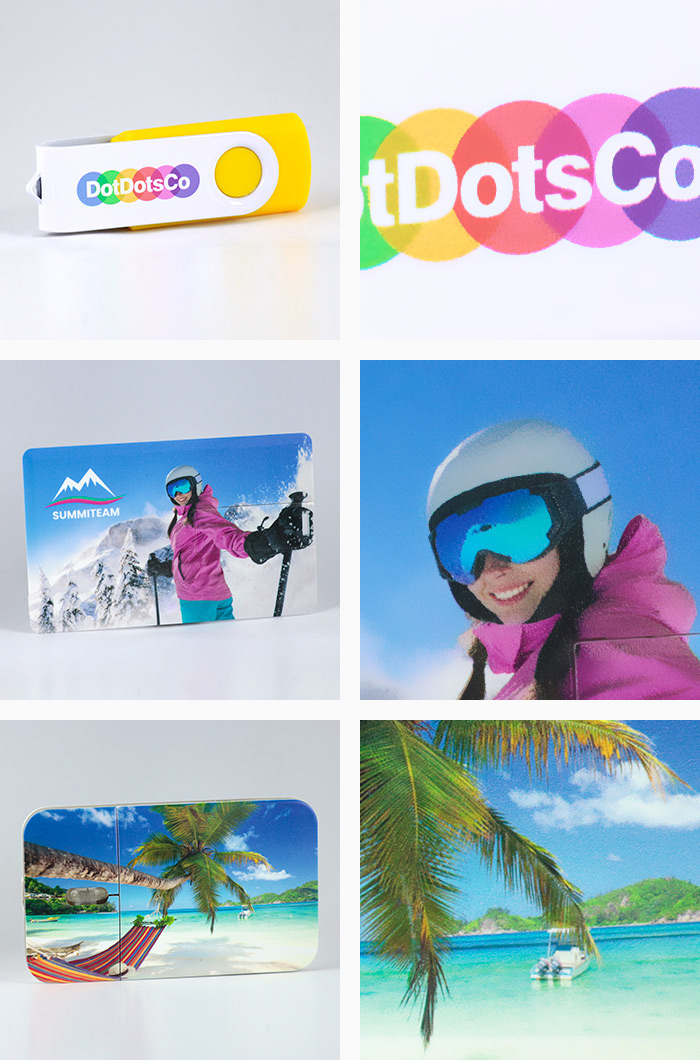
Full-color print
It is made in CMYK digital printing technology. The printing plotter prints directly on the item. Precision computer-controlled heads move over the printed surface to create the image. At the same time, UV lamps fix the ink – the technique allows to make a very durable print. Thanks to the work in the CMYK digital color palette and very high resolution, the print has the greatest number of details, giving the effect of a “photo”.
Metal and aluminum, plastics, cardboard.
Doming - 3D sticker
The term “doming” comes from “a rounding that resembles a dome.” A logo is digitally printed on the self-adhesive material . The desired shape of the sticker is cut out on the plotter, and then a layer of polymer resin is applied to the surface. This layer is crystal clear, so that the logo is not only protected from staining and scratches, but also looks slightly enlarged and highly decorative.
Selected aluminum and plastic memory models.

Embossing
The logo is etched on a metal stamp and then pressed into the material of the item. The material must be resistant enough to withstand the pressure of the machine, and the surface must be even and flat.
Leather and leather-like materials.

Illuminated logo
The special engraving is illuminated from underneath by LED.
Selected models of computer mice
Original and unique marking effect

Data uploading
Our USB flash drives can be supplied with uploaded content such as presentations, catalogs, videos, promotional and teaching materials, etc.

Screen printing
The screen printing process involves passing ink through a screen printing matrix, which is a frame with a mesh (ink-permeable material) stretched over it. Areas of the screen that are not to be covered with paint are blocked using specially hardened stencils (e.g. photopolymer). Through the holes in the screen printing, the ink is transferred to the material on which the printing takes place. After applying the paint to the material, the paint is dried or hardened to ensure the durability of the print
Fabrics, paper, plastic, metal, wood
DTF
DTF or “Direct to Film” is printing directly on foil. This is a digital printing technology that involves applying paint to a special foil through a print head and then transferring the pattern to the target surface. DTF is an alternative to other printing methods such as DTG (“Direct to Garment”) or sublimation
Cotton, polyester, denim and others
Flex foil
Flex foil is a thermal transfer foil used to decorate and personalize clothing. Flex foil is prepared using a cutting plotter that cuts out a pattern or text on the foil. Then, using a heat transfer press, the Flex foil is transferred to the clothing material under the influence of high temperature and pressure. The adhesive on the foil is activated during application, which permanently attaches the foil to the fabric
Cotton, polyester, elastane and others
Printed label
Personalization with labels is performed on advertising care and protection products from the CARE Stock category. The labels are made using digital printing technology – more details about this method in the text above. Both personalized and standard labels are made free of charge
Packaging personalization
We offer a wide selection of marking and personalization methods for our packaging.
A full range of box designs and patterns can be found in the BOXforUSB catalog.

Laser engraving
Elegance, durability and premium effect.
Available on metal Tinbox type packaging.

Pad printing
Precision of color and detail reproduction.
Available on virtually all packaging models, both cardboard (Giftbox, Casebox, Coverbox, Cardbox) and metal (Tinbox).

Full-color print
Photographic quality and full-color.
Available on all packages with “Print” (Giftbox Print, Casebox Print, Coverbox Print, Cardbox Print and Easybox Print).

Glossy / matt film
“Print” boxes can be finished with high quality foil in two types:

Hot stamping
Luxury marking method of embossing the mark together with gold or silver foil. Available on packaging: Giftbox, Casebox, Coverbox, Cardbox, as well as Easybox.
